
A morning routine checklist for adults is a short list of small habits you do after waking up, so you start the day calmer and more focused instead of rushed. The best ones are simple: wake up at the same time, drink water, get some daylight, stay off your phone for a while and set one intention for the day. Below you’ll find my 10-step morning routine list for adults, sample 15, 30 and 60-minute routines, and a free printable morning routine checklist PDF with a daily routine chart.
You don’t need a perfect two-hour routine to feel the difference. A few steps you actually repeat will do more than a long list you abandon after a week. So read through, pick what fits your mornings and leave the rest.
Free morning routine checklist for adults (PDF)
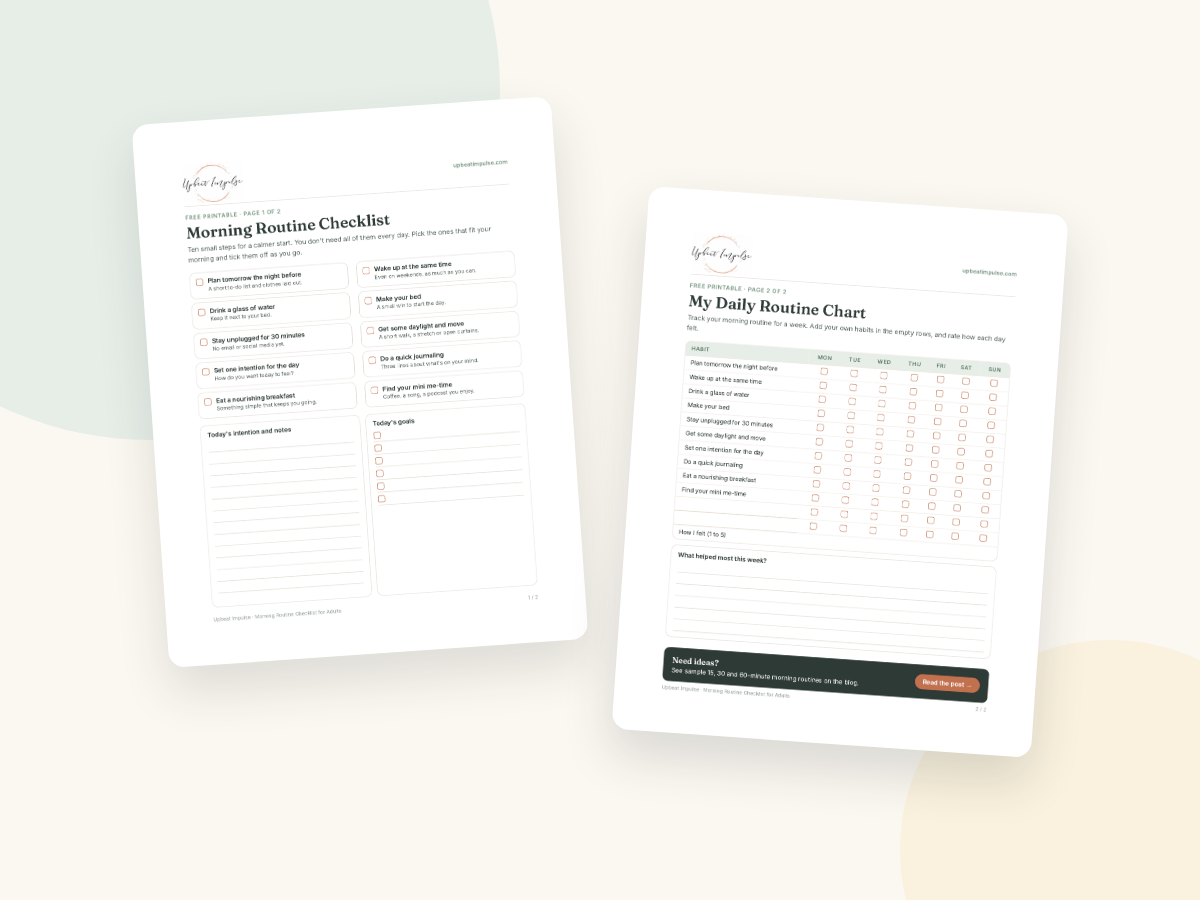
The free printable has two pages. The first is a morning routine checklist with the 10 steps from this post, plus space for today’s intention, notes and goals. The second is a daily routine chart for adults: a weekly tracker where you tick off your habits from Monday to Sunday, add your own and rate how each day felt. It works as a simple morning routine template you can print as many times as you like.
Free download
Morning routine checklist for adults, free PDF
A printable morning routine checklist with ten small steps, plus a weekly daily routine chart to track your habits. Enter your email and it's yours to download right away.
You'll also get occasional emails from me. Unsubscribe anytime.
Why a morning routine helps
When every morning starts in a rush, with alarms, notifications and a mental list of everything you have to do, your stress response kicks in before the day has really begun. A calm, predictable routine works the other way. It takes small decisions off your plate, gives you a few minutes for yourself and makes it easier to set your focus for the day.
Some of the habits also have research behind them. Waking up at the same time every day, weekends included, is one of the CDC’s main tips for better sleep (CDC). Morning daylight helps set your body clock, which supports better sleep at night (research review). And regular movement is good for both your body and your mood (NHS). The rest, like making your bed or playing a song you love, is about how you want your mornings to feel.
Morning routine checklist: 10 steps for adults
These are the steps on the printable morning routine list. You don’t need all ten every day. Start with three or four and add more once they feel natural.
1. Plan tomorrow the night before
The calmest mornings start the evening before. Write a short to-do list for the next day, lay out your clothes and get your bag ready. When you wake up, you won’t waste time and energy deciding what to do first. It also helps to look at how long your morning activities really take, so you can plan your time realistically.
2. Wake up at the same time
Rather than cutting your sleep short to fit in a longer routine, try waking up at the same time every day, even on weekends. Most adults need at least seven hours of sleep, and a steady schedule makes it easier to fall asleep and wake up (CDC). If you want more time in the morning, go to bed a little earlier instead.
3. Drink a glass of water
You haven’t had anything to drink for hours, so a glass of water is a simple way to start. Keep one next to your bed so it’s the first thing you see. If you like, add a slice of lemon. It won’t transform your health, but it can make the habit more pleasant.
4. Make your bed
Making your bed takes two minutes and gives you a small win before the day has started. It also takes away the temptation to crawl back in, and coming home to a tidy bed in the evening feels good too.
5. Stay unplugged for the first 30 minutes
Checking email and social media first thing in the morning pulls you straight into other people’s priorities and can make you anxious before you’ve even had breakfast. Try leaving your phone alone for the first 30 minutes. Turning off notifications overnight helps a lot. Messages will still be there once you’re awake and ready.
6. Get some daylight and move your body
Open the curtains, step onto a balcony or take a short walk. Morning light tells your body it’s daytime, and a little movement wakes you up more than any amount of scrolling. It doesn’t have to be a workout. Ten minutes of stretching, yoga or a walk around the block is enough to feel more awake and energized.
7. Set one intention for the day
Before the day pulls you in, take a moment to decide how you want it to go. Ask yourself one question, such as “How do I want today to feel?” or “What’s the one thing that matters most today?” Keep it positive and simple. The goal isn’t to plan for every possible problem, but to choose your focus. Some people like to add a short mantra or affirmation here.
8. Do a quick journaling
Writing just three lines about what’s on your mind can help you sort your thoughts, put worries on paper and start the day with more clarity. Whenever I did a quick morning journaling, my anxiety went down and I felt clearer about what I needed that day. There’s no right way to do it. A notebook and five minutes are enough.
9. Eat a nourishing breakfast
If you’re hungry in the morning, a simple meal that combines protein, fiber and some healthy fat will keep you going longer than something sugary. Think eggs on toast, yogurt with fruit and oats, or nut butter on whole-grain bread. It can take as little as 10 minutes. If you’re not a breakfast person, that’s fine too. Eat when your body asks for it.
10. Find your mini me-time
The little rituals you enjoy make mornings something to look forward to. It might be your coffee in a favorite mug, a song that always lifts you up, an inspiring podcast or a few minutes of quiet. Keep the heavy news for later. If it makes you happy and takes only a few minutes, it belongs on your morning routine list.
Sample morning routines for adults
Not every morning has the same amount of time. Here are three sample morning routines you can use as a template. Pick the one that fits your day.
15-minute morning routine (busy days):
- Drink a glass of water (1 minute)
- Make your bed and open the curtains (3 minutes)
- Stretch or do a few slow breaths by the window (5 minutes)
- Set one intention for the day while you get ready (6 minutes)
30-minute morning routine:
- Water and make your bed (5 minutes)
- Short walk or stretching in daylight (10 minutes)
- Quick journaling and one intention (5 minutes)
- Simple breakfast with music or a podcast (10 minutes)
60-minute morning routine (slow mornings and weekends):
- Water, make your bed and open the windows (5 minutes)
- Walk outside, yoga or a workout (25 minutes)
- Shower and get ready without your phone (10 minutes)
- Journaling and setting your intention (10 minutes)
- Breakfast and your favorite me-time ritual (10 minutes)
How to use the daily routine chart
The second page of the free PDF is a daily routine chart for adults. Write down the habits you want to keep, or use the ten from the checklist, and tick each one off on the days you do it. At the end of the week, look at the chart and rate how each day felt. You’ll quickly see which habits make the biggest difference for you, and which ones you can drop. Print a new chart every week, or keep one on the fridge and use a pencil. If you add a few habits for later in the day, like a lunch walk or an evening wind-down, it works as a daily routine checklist for adults too.
How to stick with your morning routine
- Start small. Three habits you repeat are better than ten you try once.
- Attach habits to something you already do. Drink water as soon as you turn off the alarm, set your intention while the coffee brews.
- Prepare the night before. Water by the bed, clothes ready, phone charging in another room.
- Be flexible. On busy days, use the 15-minute version instead of skipping your routine completely.
- Track it for a few weeks. The daily routine chart shows your progress, and seeing it on paper is motivating.
If mornings feel hard because you’re exhausted no matter how much you rest, it may be more than a routine problem. My burnout recovery plan can help, and so can these relaxing activities for adults for the end of the day.
Morning routine checklist for adults: FAQs
What should be on a morning routine checklist for adults?
A good morning routine checklist includes a few simple habits: waking up at the same time, drinking water, getting some daylight and movement, staying off your phone for a while, setting an intention for the day and having a nourishing breakfast. Pick the ones that fit your mornings.
How long should a morning routine take?
Anywhere from 15 to 60 minutes. A short routine you do every day is more helpful than a long one you can’t keep up. Try the 15-minute version on busy days and a longer one on weekends.
Should I wake up earlier to have a morning routine?
Only if you can go to bed earlier too. Most adults need at least seven hours of sleep, so cutting sleep to fit in a routine usually backfires. A steady wake-up time matters more than an early one.
Is there a printable morning routine checklist PDF?
Yes. You can download the free morning routine checklist for adults PDF by entering your email in the form above. It includes the 10-step checklist and a weekly daily routine chart.
What’s the difference between a morning routine and a daily routine?
A morning routine covers the first part of your day, from waking up until you start work or your main tasks. A daily routine includes the whole day, like meals, work blocks, movement and your evening wind-down. The daily routine chart in the free PDF works for both.

I'm not a therapist, just someone who gets overwhelmed easily and reads the research on what helps. I test small calming habits on myself and share the ones that work, in plain words.
More about me →