
Some people leave you feeling lighter. Others leave you tired, tense or quietly doubting yourself, and you can’t always say why. If someone in your life keeps having that effect on you, it helps to know the common toxic people signs. Once you can name what’s happening, it’s easier to decide what to do about it.
A quick note first
“Toxic” isn’t a diagnosis. It’s an everyday word for a pattern of behavior that keeps hurting the people around it (WebMD). One rude comment doesn’t make someone toxic, but a steady pattern does. That pattern can show up in a friend, a partner, a parent, a coworker or the neighbor next door.
How you feel around a toxic person
Often the first clue isn’t what they do. It’s how you feel. The most common toxic people symptoms show up in you:
- You feel drained after time together, even when nothing “big” happened.
- You feel tense before you see them and relieved when they leave.
- You walk on eggshells so you don’t set them off.
- You second-guess your memory or your feelings.
- You feel small, guilty or “too much.”
- You replay conversations long after they’re over.
Can a toxic person make you physically sick?
Ongoing conflict is a real source of stress, and stress affects the body. Research links frequent negative interactions with family, friends and partners to health problems over time, including high blood pressure (Hostinar, 2015). In a long-running study of British civil servants, people whose close relationships were full of negative exchanges had a higher risk of heart problems (De Vogli et al., 2007).
That doesn’t mean one difficult person will make you ill. But if your body tightens up every time a certain name appears on your phone, it’s worth paying attention to.
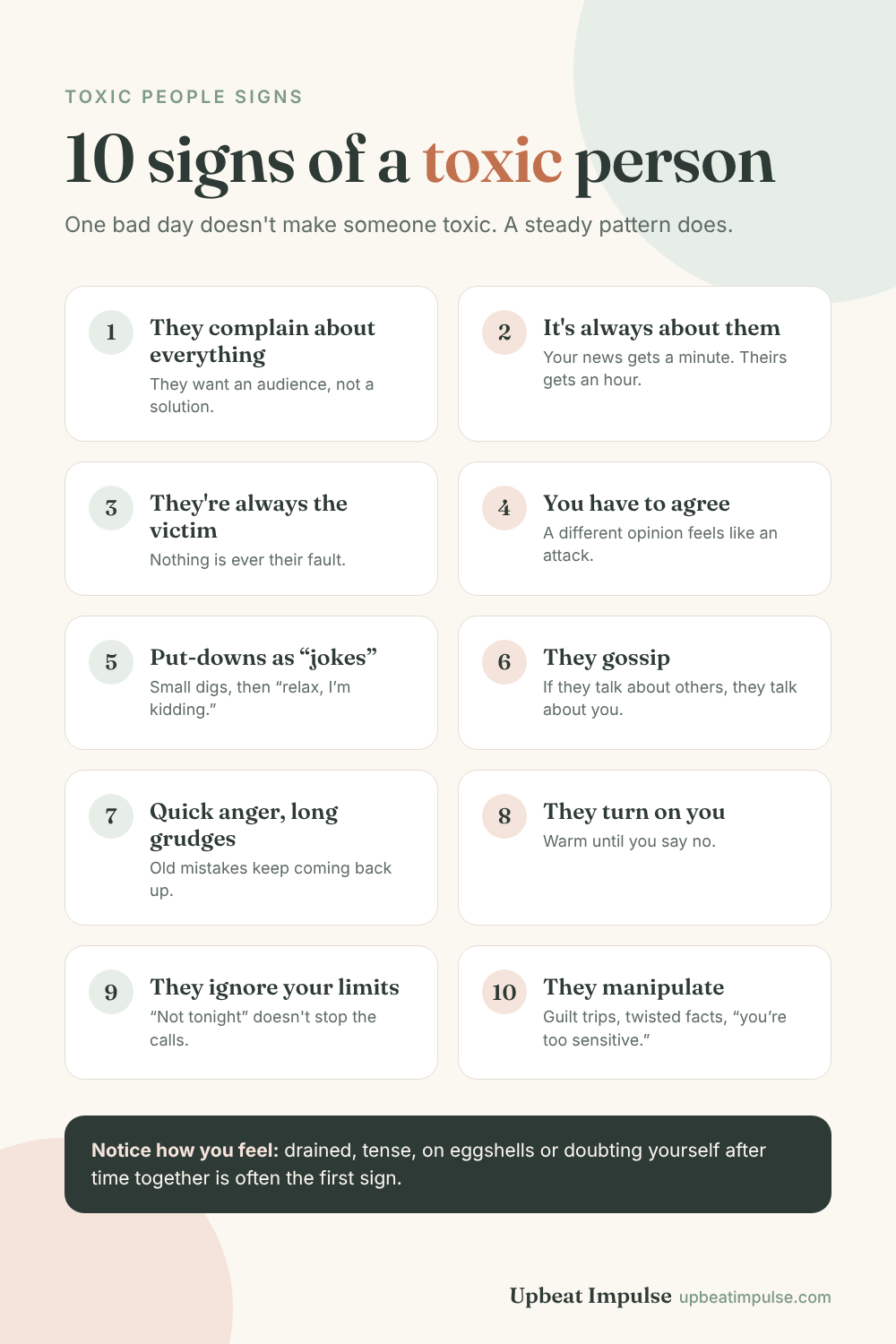
10 signs of a toxic person
These are the traits of toxic people that come up again and again. Most people show one of them on a bad day. What makes someone toxic is how often it happens, and whether anything changes when you point it out.
1. They complain about everything
Everyone needs to vent sometimes. With a toxic person, though, nothing is ever good enough, and every suggestion you make gets brushed aside. They don’t want a solution. They want an audience.
2. Every conversation comes back to them
You start telling them about your week, and within a minute you’re talking about theirs. Your news, worries and wins get very little room.
3. They’re always the victim
Nothing is ever their fault. The boss, the ex, the family and the neighbors are always to blame. Sooner or later, you will be too.
4. You have to agree with them
A different opinion feels like an attack to them. If you push back, you get sulking, a raised voice or the silent treatment, so you learn to stay quiet.
5. They put you down, often as a “joke”
Small digs about your looks, your choices or your work, followed by “relax, I’m kidding.” Over time, these comments wear down how you see yourself.
6. They gossip
They often have something unkind to say about people who aren’t in the room. Listen to that. If they talk about others this way, they probably talk about you too.
7. They get angry quickly and hold grudges
Small things set them off, and old mistakes keep coming back up. Apologies don’t seem to count.
8. They turn on you when you say no
They’re warm as long as you go along with them. The moment you set a limit or make your own choice, they get cold, critical or even vindictive.
9. They ignore your boundaries
You say you can’t talk tonight, and they keep calling. You ask them not to bring something up, and they bring it up anyway. They may also try to control who you see or how you spend your time.
10. They manipulate
Guilt trips, twisted facts, lies and “you’re too sensitive.” You leave conversations unsure of what actually happened, or agreeing to things you didn’t want.
Toxic, or just going through a hard time?
People under a lot of stress, grief or burnout can be short-tempered and self-focused for a while. That’s different from a long-term pattern. A few questions can help you tell the difference:
- Is it a phase or a pattern? Has it been going on for months or years, across different situations?
- Do they take responsibility? When you tell them something hurt, do they listen and try, or do they turn it around on you?
- Can you say no safely? Can you disagree without paying for it later?
- What’s the overall balance? Is the relationship mostly good with hard moments, or mostly hard with a few good ones?
If most of your answers point the same way, you’re likely dealing with a toxic person rather than someone having a rough season.
Toxic people in your family, friendships, work and neighborhood
The signs are similar everywhere, but each place comes with its own challenges.
Family. Signs of a toxic family member include criticism that’s dressed up as concern, constant comparisons, guilt when you make your own choices and “family rules” you’re not allowed to question. Family is the hardest place to step away from, so lower contact is often more realistic than no contact.
Friends. A toxic friend shows up mostly when they need something, competes with you instead of cheering for you, or shares things you told them in confidence.
Work. A toxic coworker takes credit for your work, spreads rumors or quietly undermines you. Keeping important requests and agreements in writing protects you, and HR or a manager may need to know if it continues.
Neighbors. Toxic neighbors may complain about everything, ignore property lines or try to intimidate you. Stay calm and brief, keep a written record with dates, and look into local mediation services or your city or council for ongoing disputes. If you ever feel threatened, contact the police.
How to deal with toxic people
You can’t control how someone else behaves. You can control how close you let them get.
- Decide what you want. Do you want to keep this relationship, limit it or end it? Your answer shapes everything else.
- Set one clear limit and say it simply. For example: “I’m not going to talk about my weight. If it comes up, I’ll head home.” Then follow through.
- Keep it short. You don’t owe a long explanation. The more you justify yourself, the more there is to argue with.
- Try being boring. With someone you can’t avoid, like a relative or coworker, calm and brief replies give them less to react to. This is sometimes called the “gray rock” approach. It can help with difficult people, but it’s not a fix for an abusive relationship.
- Lower the dose. Shorter visits, meeting in public, a set end time or a phone call instead of a whole afternoon can all help.
- Stop trying to fix them. Changing is their job, not yours.
- Spend time with people who feel good. Supportive relationships help soften the stress that difficult ones cause.
- Step back if nothing changes. If limits are ignored again and again, distance may be the kindest option, for you.
Why do I keep attracting toxic people?
If this keeps happening, it’s natural to wonder why. It’s not your fault, but some patterns can make it more likely:
- You’re a good listener. People who take more than they give tend to find people who give.
- It feels familiar. If you grew up around criticism or unpredictable moods, these dynamics can feel normal.
- Being alone feels scary. When loneliness feels unbearable, almost any company can seem better than none. But the wrong company often feels lonelier than being on your own.
- Your self-esteem is low. Put-downs feel easier to accept when part of you already believes them.
- Saying no is hard. People who push boundaries often test them early.
What helps is noticing the early signs, practicing small no’s, getting comfortable spending time alone and building a kinder relationship with yourself. When you feel steadier on your own, toxic behavior is easier to spot and easier to walk away from. If you’d like a place to start, these self-esteem worksheets can help.
What if I’m the toxic one?
If you’re asking this, that’s a good sign. Everyone has toxic traits sometimes. A few honest questions to ask yourself:
Do I often feel like everyone is against me?
Do I make jokes at other people’s expense?
Is it hard for me to apologize without adding “but”?
If some of these hit home, start small. Notice the moment it happens, apologize for something specific, and ask someone you trust how you come across. A therapist can also help you understand where these patterns come from.
When “toxic” is really abuse
Some behavior goes beyond toxic. If someone threatens you, hurts you, controls your money, checks your phone, cuts you off from friends and family, or makes you afraid, that’s abuse. If you suspect narcissistic abuse, this post on the signs of narcissistic abuse may help.
Start with how you see yourself
2 free self-esteem worksheets
“Defining the basics” and “Reframing my thoughts,” from my Self-Esteem Workbook. Printable, private and yours to keep.
Toxic people: FAQs
Can a toxic person change?
Yes, if they see the problem and want to change it, often with professional help. What you can’t do is make them change.
Do toxic people know they’re toxic?
Some don’t see the effect they have. Others do and don’t care. Either way, you’re allowed to protect yourself.
Is “toxic personality disorder” a real diagnosis?
No. There’s no such diagnosis. Some toxic behavior overlaps with conditions such as personality disorders, but only a qualified professional can diagnose those.
What are the warning signs of a toxic relationship?
You often feel worse after time together, you walk on eggshells, you feel cut off from other people, and your limits keep getting ignored.
What is toxic positivity?
Toxic positivity is pressure to stay positive no matter what, which brushes aside real feelings like sadness, fear or anger (Psychology Today). “Good vibes only” sounds nice, but hard feelings need space too.
I’m not a therapist. This post is for general information and isn’t a substitute for professional support.

I'm not a therapist, just someone who gets overwhelmed easily and reads the research on what helps. I test small calming habits on myself and share the ones that work, in plain words.
More about me →I'm not a therapist, just someone who gets overwhelmed easily and reads the research on what helps. I test small calming habits on myself and share the ones that work, in plain words.
More about me →